Emergency preparedness
Overdue vessel procedures for small commercial boats: shore contacts, sailing details, and when to call the Coastguard
Before the boat leaves, agree on an overdue vessel procedure. Name the shore contact, set the check-in times, and decide when a missed check-in will be escalated. If the boat misses that time and cannot be reached by radio or phone, the shore contact should call 999 and ask for the Coastguard.
The shore contact should have the vessel's name and description, the number of people on board, the planned route, and the expected return time ready. Add this procedure to your safety management system (SMS), clearly assign the shore contact, and test it so any alarm is raised within minutes, not hours.
This applies to workboats, charter and trip boats, RIB operators, small ferries, sailing school and dive boats, and fishing vessels. It is especially important for boats that go out with only one person or a small crew.
Why the first hour matters
On the night of 13 October 2026, the 8-metre fishing vessel Kilda did not return to Port of Ness on the Isle of Lewis. She was reported overdue at about 9:20pm. Coastguard aircraft, RNLI lifeboats, and a local vessel searched in strong winds. One crew member's body was found in the early hours, while two men and the vessel were still missing. The MAIB has started a preliminary assessment. The cause of the loss is not known, and nothing here suggests what did or did not happen on board.
This case shows that it is often someone on shore who notices a problem first. When a small boat gets into trouble quickly, there may be no Mayday, DSC alert, or beacon activation. The search only begins when someone ashore realises the boat is late and decides to call. Every minute between when the boat should be back and when 999 is called means lost daylight, drift, and survival time.
An overdue procedure takes the guesswork out of this decision. The time to call is set in advance, so it is not left to a worried relative or a harbour office hoping the crew just forgot to call.
What to agree before departure
HM Coastguard's advice is straightforward: tell someone ashore your route and expected return time, so they can call 999 and ask for the Coastguard if you are overdue. For commercial operations, write down these sailing details and leave them with a named shore contact before every trip:
- Vessel name, type, length, hull and superstructure colours, distinguishing marks — so aircraft and lifeboats know what they're looking for.
- Call sign, MMSI, and EPIRB/PLB HEX IDs — to match any alert or radio traffic to your boat.
- People on board: number, names, and passenger list for charter or ticketed trips — for search planning and casualty accounting.
- Departure point and time — the starting point for drift and search areas.
- Intended route, working area or fishing grounds, and any planned stops — where to look first.
- Expected return time and place — the point from which "overdue" is measured.
- Check-in times and how check-ins will be made (VHF, phone, text, tracking app) — so the shore knows when a check-in has been missed.
- Safety and communications kit carried: liferaft, EPIRB, PLBs, VHF DSC, flares — tells rescuers what alerts and survival aids to expect.
- Skipper's mobile number and a second contact on board — more ways to raise the boat before escalating.
The shore contact should be someone who will be reachable and awake for the whole trip, and who knows what to do. This could be an office manager, harbour office, another skipper, or a family member. If plans change at sea, such as a new area or a later return, the skipper must update the shore contact before the original return time.
Setting escalation times
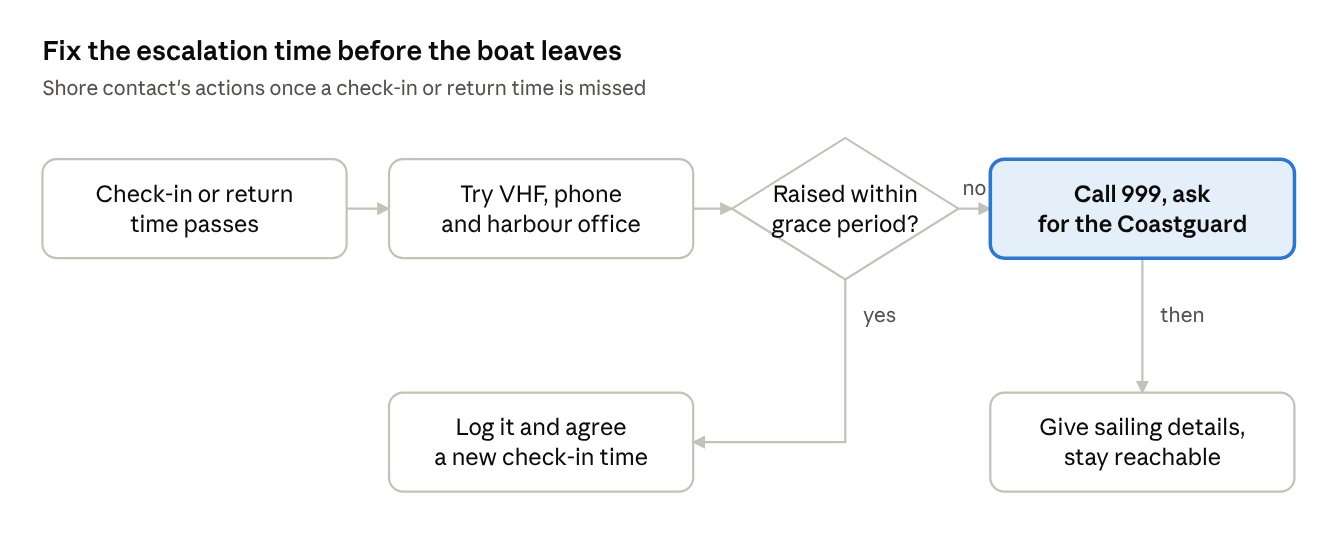
The only decision left on the night is whether the boat has responded. Everything else, including how long the shore contact should keep trying and who they must alert, is decided and written down in advance.
- Check-in schedule. Agree on check-ins at departure, at set points or intervals, and on arrival back at the dock. A trip boat on a two-hour run might check in only at departure and return, while a lone workboat or fishing vessel working all day may need several check-ins.
- Grace period. Set a short, fixed time after a missed check-in for the shore contact to try every way to reach the boat. This includes VHF, the skipper's and crew's mobiles, the harbour office, and other nearby boats. Write the number of minutes into the SMS.
- Escalation. When the grace period ends with no contact, the shore contact calls 999 and asks for the Coastguard. They should not wait for permission from a manager or owner, but should inform them straight after making the call.
- Weather and darkness. Shorten the grace period for night returns, poor visibility, bad weather, or if there is only one person on board. The Coastguard would rather cancel a search for a boat with a flat phone than start one hours late.
If the boat turns up or calls in after the Coastguard has been alerted, the shore contact should inform them right away so search teams can be stood down.
What the Coastguard will ask: a script for the shore contact
When you call 999, tell the operator you need the Coastguard. Read from the sailing details instead of relying on memory, and make sure the shore contact has this information ready. Print it and keep it with the shore contact.
- "I'm reporting an overdue vessel. My name is … and I'm calling from … on …" (give a number you'll keep free).
- Vessel name, type, length and colours; call sign and MMSI if known.
- Number of people on board, with names if you have them.
- Where and when she left, the intended route or working area, and where and when she was due back.
- When you last heard from the boat, and how.
- What you've already tried: VHF, mobiles, harbour office, other boats.
- Safety kit on board: liferaft, EPIRB or PLBs, VHF DSC, lifejackets.
- Weather and sea conditions where she was working, if you know them.
Stay by the phone, keep the line free, and follow the Coastguard's instructions. After making the call, the shore contact should inform the vessel's owner or the designated person ashore.
Lone operators, equipment and the SMS
Lone and small-crew operations. Single-handed fishing vessels, workboats, and early-morning or late-evening returns carry the most risk, because nobody on board can raise the alarm if the skipper is unable to. Use shorter check-in intervals and make sure the shore contact is definitely on watch. Agree on what happens if the skipper simply forgets to call in, so missed calls do not become a habit that delays a real response.
Equipment that alerts without the shore. A VHF DSC radio linked to GPS can send a distress alert with your position at the press of a button. Registered 406 MHz EPIRBs and PLBs alert the Coastguard directly. Under MSN 1924, the registration includes the vessel description and up to three 24-hour contacts ashore. These contacts should be the same people named in your overdue procedure and kept up to date.
Tracking apps are not a procedure. The RYA's SafeTrx app, which many small boats used for shore alerts, closed in the UK on 31 December 2025. Any app or tracker can fail or be withdrawn. A written procedure, with a named person and a fixed escalation time, still works when technology does not.
Add the procedure, the sailing details form, and the shore contact list to your safety management system's controlled documents. Brief new crew and shore staff on it, and test it. For example, run a drill where a check-in is deliberately missed, and the shore contact follows the script without actually calling 999. Record late returns and missed check-ins as near misses so you can spot patterns.
How Helmsman helps
Helmsman will not make the call for you, but it keeps all the information and evidence in one place so the person ashore can act quickly.
- No record ashore of route, expected return time or who is on board. Plan Voyage records each trip's route, planned departure and arrival, and crew, and links a charter trip to its booking, so the shore team can see the passenger count with the trip.
- Overdue procedure exists only in someone's head, or the contact list is out of date. Document control holds your procedures with version history, approval and review dates, and tracks who has acknowledged them. Write your emergency and overdue procedure there, with your shore contacts in it.
- Beacons not registered, or past battery or service dates. The lifesaving equipment register tracks EPIRB and PLB details and expiry dates and flags items coming due.
- Late returns and missed check-ins never recorded. Incident reporting logs near misses and overdue events with follow-up actions, giving an audit trail for an MAIB or Certifying Authority enquiry.
FAQs
What should I do if a boat hasn't come back when expected?
Try to raise it by VHF, the crew's mobiles, the harbour office and nearby boats. If you can't make contact within the grace period in your procedure, call 999 and ask for the Coastguard.
When should I report an overdue vessel to HM Coastguard?
As soon as your agreed grace period has passed without contact. If you're worried and have no procedure, call anyway: the Coastguard would rather be told early.
What information does the Coastguard need?
The vessel's name and description, people on board, departure point and time, intended route or area, expected return time and place, when you last heard from her, and what safety kit is on board.
What should a shore contact procedure include?
A named shore contact, the sailing details form, the check-in schedule, a fixed grace period, the escalation step (999, Coastguard), and who to tell afterwards.
How often should a small boat check in?
At least on departure and on return. Add check-ins during the trip for lone operators, long days, night work or poor weather. Set the schedule in your SMS so it isn't left to the skipper's memory.
Does registering my EPIRB replace an overdue procedure?
No. A beacon only alerts when it is activated. An overdue procedure covers the cases where nobody on board can raise the alarm.
Sources
- STV News: One dead and two missing as Lewis fishing boat search faces 70mph winds (14 Oct 2026)
- STV News: Police dive units to resume search for crew and missing fishing boat off Lewis (16 Oct 2026)
- MAIB: current investigations (updated 16 Oct 2026)
- HM Coastguard: What to do in an emergency
- Marine Industry News: RYA to close SafeTrx vessel-tracking and safety app (4 Dec 2025)
- MSN 1924 (M+F): EPIRB and PLB registration requirements
Helmsman runs this six-stage process for you — capture to close-out, with the records joined up so they survive an audit.
Join the waitlistAbout this guide. Written by John Wilmans, a working skipper who has been through a domestic safety management audit from the side of the operator being audited.Reviewed by John Wilmans on 19 October 2026.
This guide is general information, not legal advice, and it describes United Kingdom — HM Coastguard and small commercial vessel operators. Requirements differ between flag states and administrations — always confirm with your own flag state or administration. Spotted something wrong?Tell me and I'll correct it.