Vessel maintenance
What to do when your only ferry breaks down: reporting defects, deciding if it's safe to sail, and planning for service disruptions
A defect reporting process ensures that every fault found on board is recorded and checked for its impact on safety. The fault is either fixed or formally risk-assessed and signed off by a specific person before the vessel sails again.
Ferry and passenger boat operators, especially those with only one vessel, also need a service disruption plan. This plan should explain who decides if the vessel is fit to sail, how passengers are informed, and what replacement options are available. These steps help ensure that business pressures do not influence safety decisions.
This advice applies to small ferries, river services, trip and charter boats, workboats, and fishing vessels. The fit-to-sail and disruption planning sections are especially important for passenger services.
When the only boat stops
In October 2026, Mersey Ferries had to stop their Liverpool–Wirral river services for seven days in a row. The suspension started on Saturday, 10 October, due to what the operator first called a "technical issue." By 16 October, it was described as a mechanical fault with the engine of Snowdrop, then the only working vessel. Royal Iris had been retired in March after 67 years, and the new Royal Daffodil was still being tested. During the suspension, commuters could use a replacement bus between Seacombe and Hamilton Square station.
News reports did not explain the cause of the fault or the vessel's maintenance history, and this guide does not make any assumptions about them. The main point is the situation the operator faced. Anyone running a single-vessel ferry, a seasonal trip boat, or a one-boat charter business knows this scenario: a defect appears, and the entire service depends on one decision — whether the boat can safely operate.
Recording and grading a defect
Planned maintenance is for the work you schedule ahead of time. A defect procedure is for anything unexpected, like a fault found during a pre-departure check, an alarm during a trip, or a crew member reporting a leak. The goal is to make sure no defect is forgotten or just written on a scrap of paper between shifts.
What to capture, every time:
- Vessel, system and item (for example, main engine 2, cooling water pump)
- What was found, when, and by whom
- Photos, alarm readings or engine hours where relevant
- Immediate action taken (isolated, stopped, temporary repair)
- Severity grade (below), owner and due date
- Link to the related planned maintenance task, if there is one
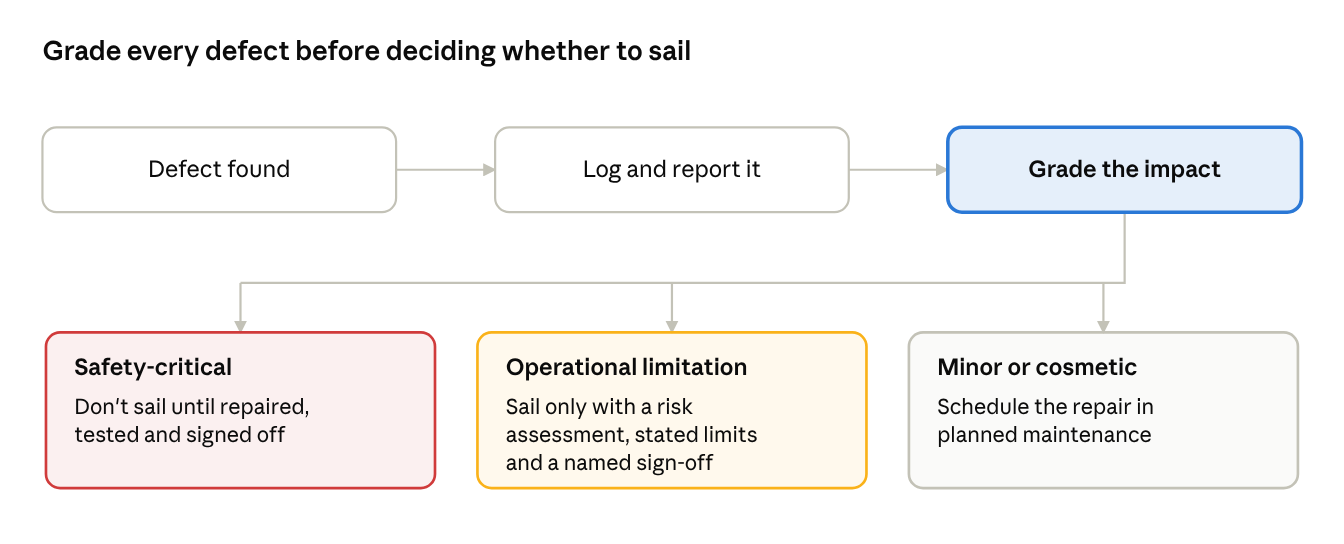
Grade the impact on safe operation:
- Safety-critical (loss or degradation of propulsion or steering, bilge pumping, fire detection, lifesaving appliances, watertight integrity): the vessel does not sail until repaired, tested and signed off.
- Operational limitation (one of two engines down, a navigation light or radar fault, a defective passenger door with an alternative exit): sails only within a risk assessment with temporary controls, stated limits and a named sign-off, and a date by which it must be fixed.
- Minor or cosmetic (worn seat covers, non-essential lighting, paintwork): scheduled into planned maintenance.
Decide in advance what is considered safety-critical, assign each defect a grade, and include this in the SMS for each vessel. This avoids last-minute arguments at the dock.
The fit-to-sail decision
The master or skipper makes the final decision about whether it is safe to sail, and the SMS should state this clearly. The SMS should also specify who must sign off if a defect is deferred, and what evidence is needed.
- Name the responsible authority clearly. For example, the master and the designated person ashore, or the operations manager, should both sign any operational limitation. Only repaired and tested safety-critical defects can be signed off.
- Set clear criteria for deferring defects. A deferred defect must include a written risk assessment, temporary controls such as fewer passengers, daylight-only trips, stricter weather limits, or an extra crew member, and a set repair date.
- Separate the people. The person under most commercial pressure, often the owner on a busy day, should not be the only signature on a deferral.
- Always check again before restarting. After a repair, test the system under real conditions and record the results before the first passenger trip. A short sea trial is better than just taking an engineer's word that it should be fine.
What the rules expect
ISM Code (larger passenger ships, ro-ro ferries and passenger high-speed craft in scope of the 2026 ISM Regulations). Section 10 requires procedures to maintain the ship, report non-conformities and their possible causes, take corrective action, and identify equipment whose sudden failure could be hazardous, with measures such as regular testing of stand-by arrangements. MGN 708 adds lay-up and reactivation procedures for seasonal or intermittent ships in the SMS.
Domestic passenger ships (DSM Code, MGN 536). The Code applies to passenger ships not already under the ISM Code. At audit, surveyors expect on-board maintenance records and all repair records, including shore contractors' work. Non-conformances must be closed out within agreed timeframes, or a major non-conformance is raised, which can lead to withdrawal of the DSM certificate. For smaller operators, the Code asks that all records about the boat, equipment, crew, and operations be gathered in one place.
Small vessel codes (Workboat Code, SCV and fishing vessel codes). The codes require the vessel to be maintained to the standard of its certification. In practice, a defect log and evidence of repair are what a surveyor or Certifying Authority will ask to see.
Reporting to the MAIB. Under MGN 564 Amendment 2, equipment defects need not be reported on their own. However, the stranding or disabling of a ship is a marine casualty, and an event that endangers safety is a marine incident. Report both as soon as practicable, by the quickest means available. A propulsion failure at sea may therefore be reportable, so check the guidance at the time rather than assuming it isn't.
Service disruption planning for single-vessel operators
Write your disruption plan when things are calm, so you are ready when problems happen. Keep it brief and store it with your SMS.
- Decision and timing. Who decides to cancel, by what time before the first sailing, and who confirms when service resumes.
- Passenger communication. Decide who will update the website, social media, booking system, and dock signs, and have template messages ready. Contact ticketed and charter customers directly and offer refunds or rebooking.
- Alternatives. Pre-agreed arrangements for replacement road transport, a chartered relief vessel (checked in advance for certification and crew), or a reduced timetable.
- Spares and contractors. Critical spares held, lead times known for the rest, and engineers' contact details with out-of-hours numbers.
- Restart checks. Make sure you have proof of repairs, carry out testing, do a short trial run, and ensure the crew is familiar with the vessel if you are using a relief or new boat.
- Stakeholders. Harbour authority, local authority or transport body, and the Certifying Authority or MCA where the defect affects certification.
Closing the loop
A defect is not considered closed just because the boat is sailing again. It is closed when you can show:
- What was done: the repair, who did it, the parts used, and the test result.
- Why it happened: a short root-cause note (wear, missed maintenance, design, operator error, supplier fault).
- What changes: an adjusted maintenance interval, a new spare held, or a revised check on the pre-departure list.
Review all defects as a team every few months. If the same pump fails three times in one season, it is a maintenance planning issue, not just bad luck. Catching these patterns early is the purpose of keeping a defect log.
How Helmsman helps
- Defects reported verbally or on paper and lost between shifts. Vessel inspections and maintenance logs each defect against vessel and system with severity, photos, owner and due date, linked to the planned maintenance task.
- Unclear who can declare the vessel fit to sail with a deferred defect. Document control holds your procedures with version history, approval and review dates, and tracks who has acknowledged them. Write your fit-to-sail and defect deferral procedure there, with the named roles in it. Risk assessments record temporary controls and sign-off.
- Sailings cancelled with no record of why. Scheduled ferry operations and charter/ticketed trips record each cancelled or altered sailing with its reason.
- Repeat faults on the same machinery never spotted. Defect and incident history per vessel and system shows patterns, supporting root-cause review and MAIB reporting where required.
Helmsman highlights and documents these steps, but the decision to sail always remains with the master and those named in your SMS.
FAQs
What should a defect reporting procedure include?
Who reports, what is recorded, how defects are graded, who can defer them and on what conditions, how repairs are evidenced, and how defects link to planned maintenance.
Who decides whether a ferry is fit to sail after a defect?
The master always has the final say on safety. Your SMS should also name who signs off any deferred defect, usually the master together with the designated person or operations manager.
Can a passenger vessel operate with a known defect?
Only if the defect is not safety-critical, the vessel still meets its certificate, and a documented risk assessment with temporary controls and a fixed repair date has been signed off. If a defect affects certification, contact your Certifying Authority or the MCA.
Do I have to report an engine failure to the MAIB?
A defect alone isn't reportable, but a failure that disables the vessel or endangers safety is a marine casualty or incident and must be reported as soon as practicable under MGN 564.
What should a ferry disruption plan cover?
Who decides and by when, how passengers are told, alternative transport or relief vessels, spares and contractors, restart checks, and which authorities to inform.
Sources
- Click Liverpool: Mersey Ferries services suspended for full week (16 Oct 2026)
- MGN 708 (M): Guidance on the Merchant Shipping (ISM) Regulations 2026
- IACS Recommendation 74: Guide to managing maintenance in accordance with the ISM Code
- MGN 536 (M) Amendment 5: Safety management code for domestic passenger ships
- MGN 564 (M+F) Amendment 2: Marine casualty and marine incident reporting (May 2026)
Helmsman runs this six-stage process for you — capture to close-out, with the records joined up so they survive an audit.
Join the waitlistAbout this guide. Written by John Wilmans, a working skipper who has been through a domestic safety management audit from the side of the operator being audited.Reviewed by John Wilmans on 19 October 2026.
This guide is general information, not legal advice, and it describes United Kingdom (MCA) — ISM Code, DSM Code, small vessel codes. Requirements differ between flag states and administrations — always confirm with your own flag state or administration. Spotted something wrong?Tell me and I'll correct it.